June 2nd, 2026 • 5 mins read
How to Prepare Teenagers for the Future
The future confronting teenagers is not merely complex; it is a huge turning point demanding a radical re-evaluation of preparedness. Relying on traditional academic benchmarks for tomorrow’s uncertainties guarantees obsolescence. The true safeguard for our adolescents lies not in rote knowledge, but in cultivating an unwavering Growth Mindset, the psychological engine that transforms challenges into opportunities, effort into mastery, and failure into vital feedback.
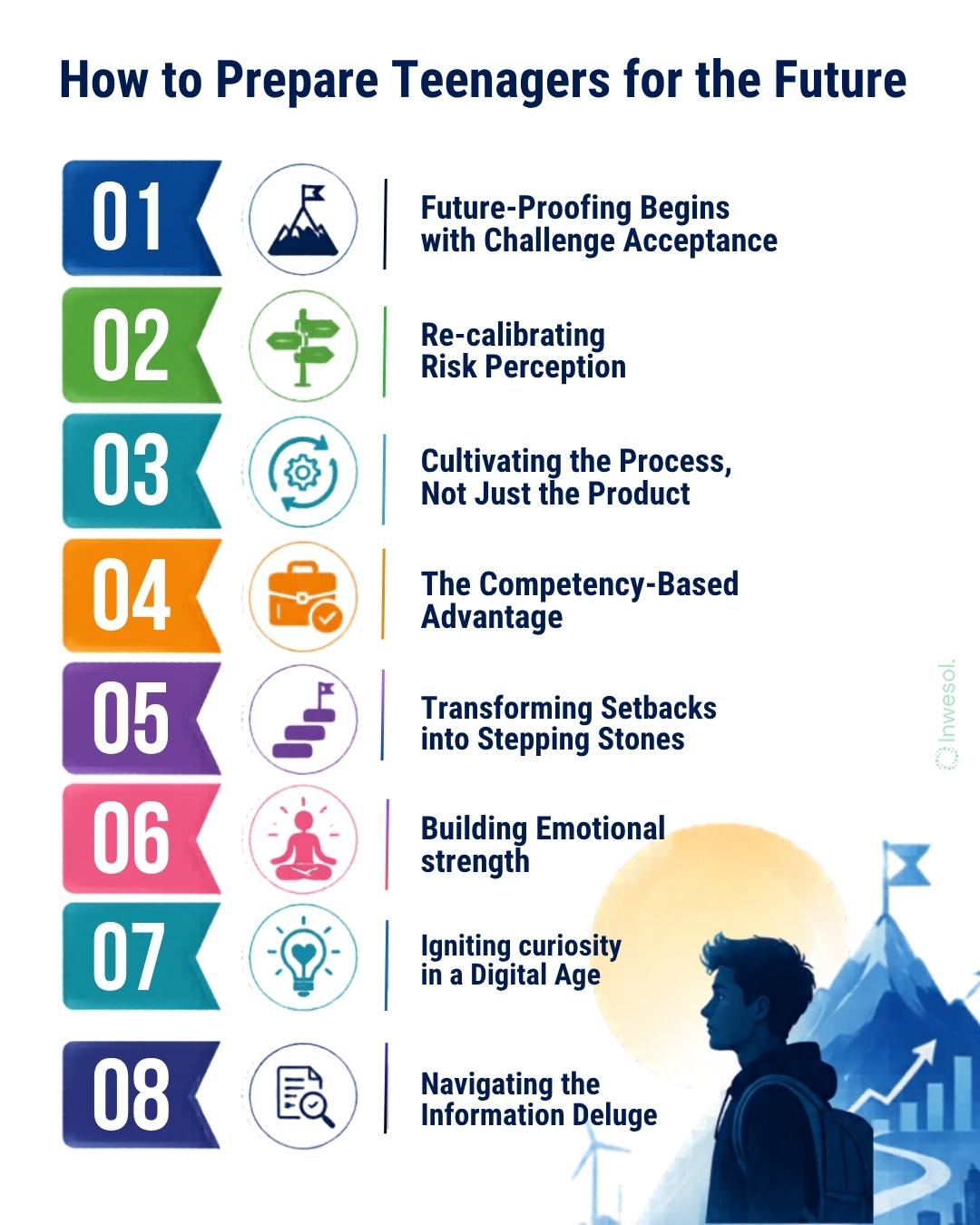
1. Future-Proofing Begins with Challenge Acceptance
Parents can actively equip teenagers to embrace unforeseen obstacles as fundamental learning opportunities. The impulse to shield children from difficulty, while natural, inadvertently fosters a fixed mindset, where intelligence and ability are seen as static traits rather than developed capacities. This psychological bottleneck paralyzes progress in a world defined by rapid technological flux and societal transformation.
Redefine Success: Shift the conversation from flawless performance to persistent effort and strategic adaptation.
Model Resilience: Share personal instances of overcoming professional or personal setbacks, demonstrating the process of recovery and learning.
2. Re-calibrating Risk Perception
Teenagers require a framework for assessing and engaging with uncertainty, rather than retreating from it. This means fostering psychological safety, enabling them to experiment, fail, and iterate without fear of severe judgment.
Encourage Exploration: Support their pursuit of varied interests, even those without clear career paths, as these build diverse skill sets.
Analyze Outcomes: Guide them to dissect the lessons from both successes and missteps, focusing on process improvements for next attempts.
3. Cultivating the Process, Not Just the Product
Parents should prioritize and celebrate the journey of skill acquisition and problem-solving over singular achievements like test scores or specific college acceptances. The emphasis on competency-based learning, acquiring demonstrable skills, and applying them is paramount over mere credentialism (chasing degrees or certificates ) in an automated economy.
Highlight Effort: Consistently praise the persistence, strategies, and dedication applied to tasks, not just the final grade.
Value Iteration: Teach that mastery is built through repeated attempts and refinement, paralleling how software is developed through iterative sprints.
4. The Competency-Based Advantage
The future labor market demands demonstrable skills (competencies) rather than just qualifications. This shifts the focus from what a teenager knows to what they can do.
Project-Based Learning: Encourage engagement in projects that require research, planning, execution, and presentation, translating abstract knowledge into tangible output.
Skill Documentation: Guide them to create portfolios or digital showcases of their capabilities, transcending the limits of a traditional resume.
5. Transforming Setbacks into Stepping Stones
Teenagers must learn to view failure not as a verdict on their worth, but as a highly valuable data point for improvement. This cognitive reframing is critical for building the mental toughness required to navigate a volatile world.
Deconstruct Failure: Help them objectively analyze what went wrong, what was within their control, and what could be done differently.
Normalize Mistakes: Create an environment where mistakes are openly discussed as integral parts of any learning or innovation process, removing their stigma.
6. Building Emotional Strength
Navigating future ambiguity requires robust emotional regulation and a strong sense of self-belief. This strength is built through guided experiences of overcoming difficulties.
Mindfulness Practices: Introduce simple techniques to manage stress and anxiety, enhancing their ability to respond thoughtfully rather than react impulsively.
Self-Advocacy Skills: Equip them to articulate their needs and boundaries, fostering autonomy and resilience in social and academic settings.
7. Igniting Intrinsic Curiosity in a Digital Age
Fostering a genuine love for learning and continuous self-improvement is the ultimate future-proofing mechanism. In a world awash with information, discernment and active knowledge creation are more valuable than passive consumption.
Connect Learning to Passion: Help them identify how academic subjects can relate to their intrinsic interests, making education personally relevant.
Curate Digital Consumption: Guide them from passively scrolling to actively seeking out reputable sources, engaging in critical analysis, and creating their own digital content.
8. Navigating the Information Deluge
Teenagers are constantly exposed to vast amounts of digital content, often without the tools to critically evaluate it. Teaching digital literacy moves them beyond mere consumption.
Source Verification: Teach them to question the origins and biases of information, fostering a healthy skepticism essential for truth-seeking.
Critical Thinking Prompts: Encourage active discussion about news, social media trends, and online narratives, developing their analytical muscle.
Conclusion
The future demands not just academic proficiency, but psychological agility, the capacity to adapt, learn, and grow continuously.
A Growth Mindset is not merely a strategy; it is the fundamental operating system for a thriving future.
The Micro-Step for Tonight
Ask your teenager to describe a recent challenge they faced academically, socially, or personally. Listen actively, then ask, “What did that experience teach you, and what might you do differently next time?” This subtly shifts focus from outcome to process, reinforcing the core tenets of a growth mindset.
